Vidal Angel
A Visionary Legacy
Vidal Angel (1947–2011) was a French-born multidisciplinary artist whose practice encompassed painting, mosaic, airbrush, sculpture, ceramics, graphic design, animation, film, and mixed media. Working across Europe, Asia, the Caribbean, South America, and the United States, Angel developed a visual language shaped by postwar Paris, the psychedelic and countercultural movements of the 1960s and 1970s, Eastern spirituality, Afro-Caribbean culture, music, and the experimental art communities of Northern California.
Across more than four decades, Angel resisted identification with a single medium or artistic movement. His work instead reflected a life of cultural exchange, experimentation, spirituality, and transformation—an approach he summarized in his own words:
“Art has no borders. Art is the state of freedom.”
Biography
Early Life and Artistic Training
Vidal Angel was born in Paris, France, on January 21, 1947, in the years immediately following World War II. His family reflected the multicultural European world into which he was born. His mother’s family was Ashkenazi and Eastern European, while his father was Sephardic, with Greek-Turkish roots from Thessaloniki.
His father operated a successful clothing company specializing in raincoats and supplying major department stores. Although Vidal grew up around the family business, his interests lay elsewhere. From an early age, he was drawn to painting, drawing, animation, and music.
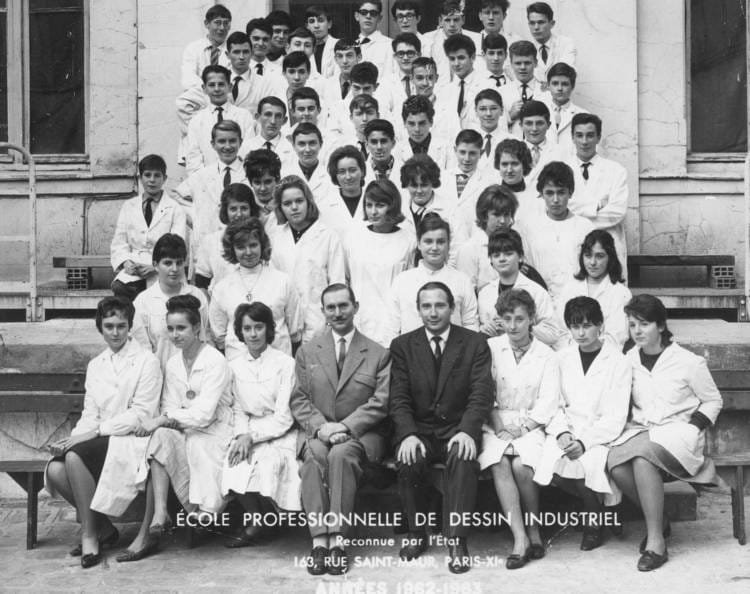
Vidal was the first of three brothers and had three older sisters. Recognizing his artistic inclination, his sister Jacotte advocated for his formal art education. He attended the École Professionnelle de Dessin Industriel (E.P.D.I.) in Paris, where he studied industrial and commercial design at a time when the school was particularly recognized for its training in publicity and applied arts.
Between approximately 1965 and 1967, Angel worked in animation on Mickey Magazine, gaining early professional experience within the world of Disney-related publishing through the French publishing house Hachette. Following this period, he turned toward freelance work and began establishing himself as an independent artist in Europe.
Paris, Music and the Psychedelic Era
By the late 1960s and early 1970s, Angel had become immersed in the Beatnik, rock-and-roll, and emerging psychedelic communities of Paris.
His brother Victor Angel was also connected to the music scene, bringing Vidal into an environment of musicians and artists that included the collaborative Zig Zag Community, a network of bands and creatives working alongside one another.
Angel’s participation extended beyond visual art. Angel became associated with bands including Triangle, Alan Jack Civilization, Tribe, Crium Delirium, and Gong. He contributed musically while also creating elaborate psychedelic poster artwork and other visual material associated with the bands and the broader rock culture surrounding them.
This period established a relationship between art and music that would continue throughout Angel’s career. Poster design, album imagery, festival graphics, portraiture, and later his depictions of musical icons became an important strand within his larger multidisciplinary practice.
Travel, Counterculture and Spiritual Exploration
Travel became fundamental to Angel’s artistic and philosophical development. Beginning in the late 1960s, he moved through Europe and the United States before undertaking extensive travels along the legendary Hippie Trail, hitchhiking through Istanbul, Pakistan, Afghanistan, and onward to India.
During his travels in 1969, Angel encountered the Morning Star community near Taos, New Mexico, part of the broader communal and countercultural movement of the period. Encounters such as these exposed him to alternative approaches to community, spirituality, artistic expression, and independent living.
During his journey toward India, Angel lost his passport, possessions, and savings. Exhausted by the ordeal, he collapsed and was taken in by a maternal figure he remembered as Mataji, who cared for him and helped him recover. The experience marked a profound turning point in his spiritual journey.
In India, Angel immersed himself in Eastern philosophy and spent time among Hindu Sadhus, practicing meditation and extended periods of silence. At one point, he lived in a tree while pursuing this period of spiritual contemplation.
His travels eventually brought him to Anjuna Beach in Goa, where he encountered an international community of European, American, and other travelers exploring communal living, spirituality, music, psychedelia, and alternative forms of artistic expression.
Among the Americans he encountered were members of the famous Hog Farm, the countercultural community associated with Wavy Gravy and the Grateful Dead. Relationships formed within these international countercultural networks would later reconnect Angel with California.
The psychedelic era left a lasting imprint on his visual language. Experimentation, spirituality, music, altered states of consciousness, and the transformation of ordinary materials would continue to surface throughout his artistic practice.
California and the American West
In 1974, Angel traveled to Los Angeles and San Francisco with his close friend Patrick Dietch, a rock-and-roll guitarist. During this period, Angel moved within California’s vibrant music and art communities, encountering musicians, artists, photographers, and other figures connected to the West Coast rock scene, including circles associated with Buddy Miles, Jefferson Airplane, and the Grateful Dead.
His experiences in Northern California made a particularly strong impression on him. The region’s convergence of experimental art, music, communal living, spirituality, and counterculture echoed ideas he had encountered during his travels and would eventually draw him back to California permanently.
Brazil and Candomblé
In 1978, Angel traveled to Rio de Janeiro to reunite with his brother Victor before continuing to Salvador, Bahia. Through his brother’s circle, Vidal encountered the Afro-Brazilian spiritual tradition of Candomblé, adding another dimension to an evolving spiritual worldview already influenced by his experiences in India and the international counterculture.
Brazil also marked an important development in his visual practice. Before leaving the country, Angel became interested in airbrush techniques applied to clothing. At a time when airbrushed apparel had not yet become widespread, he recognized the technique’s potential as a medium connecting fine art, fashion, music, and popular culture.
Jamaica, Reggae and Rastafarian Culture
By the end of the 1970s, Angel had returned to Paris and reconnected with his wife, Akua Angel, whom he knew through the Paris art scene.
Akua was a Jamaican, London-based performer who performed with prominent French pop singer Claude François. She was also the sister of guitarist Junior Marvin of Bob Marley and the Wailers.
Through Junior Marvin, Angel spent time with Bob Marley in Jamaica and was introduced more deeply to Rastafarian culture, spirituality, faith, music, and visual symbolism. Jamaica became an important part of Angel’s life and artistic development.
His connection to the island would endure. In the early 1990s, Angel was commissioned by the Marley family to create a large-scale mural of Bob Marley for the Bob Marley Museum in Kingston, Jamaica.
California, Airbrush and Multimedia
During the 1980s, Angel returned to California with his family and revived his interest in airbrush. Near San Francisco, he opened a store showcasing airbrushed clothing and Rastafarian-inspired designs, developing the technique he had first explored during his travels. The work brought together fashion, portraiture, music, spirituality, and popular imagery.
Angel also collaborated with Bay Area artist Pat Ryan on numerous projects. Their work included The Icon Makers, a body of graffiti-influenced collage work, as well as Tacky Productions, an experimental multimedia project encompassing short films and related works. These collaborations reflected Angel’s refusal to recognize rigid boundaries between fine art, commercial art, film, design, fashion, and music.
Mendocino and the Studio Years
By the late 1980s, Angel and his family relocated to a 120-acre ranch in the Mendocino Mountains of Northern California. There, art and daily life became increasingly intertwined. Their home and studio were powered by solar energy, and the family grew organic produce that was supplied to local farmers’ markets. The landscape and independent culture of Northern California provided Angel with an environment in which the many strands of his life and practice could converge.
His work during his career encompassed oil painting, bronze sculpture, ceramics, stonework, airbrush, graphic design, poster art, animation, film, collage, and mixed-media mosaic.
Poster and Graphic Art
Angel’s relationship with music extended well beyond personal association. His archive contains a significant body of psychedelic and music-related poster art, festival graphics, promotional imagery, album-related work, illustration, and graphic compositions.
Beginning with his involvement in the European rock scene, Angel used graphic art as another field for experimentation. His posters combine illustration, typography, portraiture, psychedelic imagery, and the visual vocabulary of the musical and countercultural environments in which he participated.
Rather than existing separately from his fine-art practice, these works demonstrate the fluidity with which Angel moved between graphic design and fine art, underground culture and established media, music and visual expression.
The surviving posters and graphic works also serve as cultural documents. Collectively, they preserve a visual record of the musicians, festivals, communities, and alternative cultural movements Angel encountered over several decades.
Viewed alongside his paintings, sculptures, airbrush works, films, and mosaics, the graphic archive reveals an artist whose practice was considerably broader than any single body of work.
The Roach Mosaics
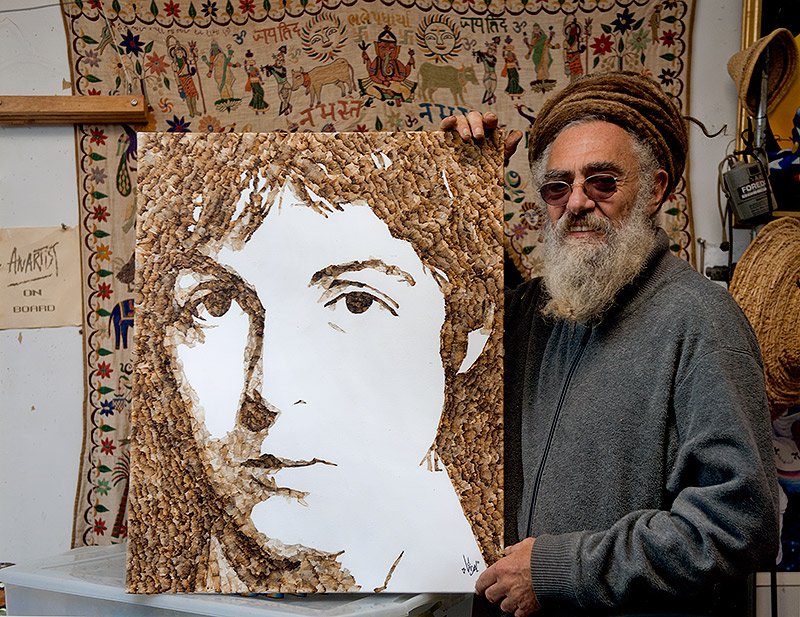
Among Angel’s most distinctive artistic contributions is his Roach Art series, begun in 1987. Using the charred remnants of Club Modiano rolling papers from his joints, Angel developed an unconventional mosaic technique in which subtle variations in burn, coloration, texture, and translucency became his palette.
Individual fragments were meticulously assembled to create complex figurative compositions and portraits of musicians, political figures, and cultural icons.
The process transformed the remnants of a personal ritual into an intricate visual medium. Materials ordinarily considered disposable became, through repetition and accumulation, objects of permanence.
In this way, the Roach Mosaics collapse conventional distinctions between high and low culture, precious and discarded materials, private ritual and public iconography.
Developed over approximately twenty-five years, the series ultimately grew to roughly thirty works and represents one of the clearest expressions of Angel’s larger artistic philosophy: the potential for transformation exists within even the most unexpected material.
Cultural Documentation and Dreads
Angel was not only an observer and interpreter of the countercultural communities surrounding him; he also became part of their visual record.
In 1999, he was included in Dreads, the photographic book by Francesco Mastalia and Alfonse Pagano, published by Artisan. The publication presented photographic portraits exploring dreadlocks across cultures and communities and featured an introduction by author Alice Walker. Angel’s inclusion provides another document of his place within the artistic, spiritual, and countercultural worlds that informed his life and work.
Rather than standing apart from his artistic biography, the portrait represents the reciprocal relationship between Angel and the cultures he documented: he was simultaneously artist, participant, and subject.
Legacy
Across more than four decades, Vidal Angel developed a body of work that crossed media, geography, culture, and conventional artistic categories.
From postwar Paris and the European psychedelic movement to India, Brazil, Jamaica, and Northern California, Angel continually absorbed new visual languages, spiritual traditions, materials, musical influences, and techniques. These experiences did not produce a succession of disconnected styles; together, they formed the vocabulary of a singular multidisciplinary practice.
His surviving archive encompasses paintings, Roach Mosaics, sculpture, ceramics, airbrush, psychedelic posters, graphic design, album and festival imagery, photography-related documentation, animation, film, and collaborative multimedia work.
At the center of that archive is a recurring interest in transformation of materials, cultural symbols, spiritual experience, and the boundaries separating artistic disciplines.
Vidal Angel died from cancer on March 17, 2011. His extensive archive remains a record of an artist whose work developed at the intersection of several defining cultural movements of the second half of the twentieth century.
Today, the breadth of that archive and particularly the singular material language of his Roach Mosaics, together with his largely undocumented body of poster and graphic work offers an opportunity for renewed curatorial examination of an artist whose work crossed the boundaries between fine art, music, counterculture, spirituality, and material experimentation.
The Art of Roach Mosaics
Vidal Angel’s iconic murals are born from an unconventional medium, the remnants of Modiano rolling papers. For each piece, Vidal smoked marijuana as part of his creative ritual, using the burnt papers to craft intricate mosaics. The natural char and shading of the roach ends formed the outlines and depth of his images, transforming discarded remnants into timeless portraits of cultural and musical icons.
On film
Exhibitions
Practice
Painting, sculpture, airbrush, ceramics and mixed media, alongside training in industrial design and animation.